
KSCSTE & KFRI
CAIK is a part of KFRI which is an institution of KSCSTE.
Analytical Services
by Sophisticated Instrumental methods.
Analytical Charges
Instrument wise charges and mode of payment..FT-IR
Make: Perkin Elmer Inc, USA
Model: SPECTRUM TWO
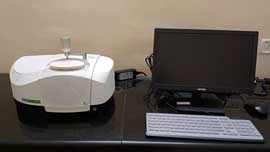
Fourier-transform infrared (FT-IR) spectroscopy, deals with the vibration of molecules. Each functional group has its own distinct vibrational energy, which can be used to identify a molecule through the combination of all of the functional groups. When infrared radiation is passed through a sample, some radiation is absorbed by the sample and some is transmitted. The resulting signal at the detector is a spectrum representing a molecular ‘fingerprint’ of the sample. The usefulness of FT-IR is that the different chemical structures (molecules) produce different spectral fingerprints, which could function as a signature pattern.
Applications
- Environment: Analysing soil, monitoring air and water quality to address environmental and health concerns.
- Food : Rapid determination of the trans-fat content of manufactured food products using Attenuated Total Reflectance (U-ATR).
- Polymers and plastics: Quickly and definitely identify compounds such as compounded plastic, blends, fillers, paints, rubbers, coatings, resins and adhesives.
Specifications
- Wave number range: 350-8300 cm-1
- Resolution: 0.5 cm-1
- Wavelength accuracy: 0.1 cm-1
- Wavelength precision: 0.01 cm-1
- ATR: ATR with monolithic diamond crystal
- Detector: High intensity ceramic light source with hotspot stabilization
- Software: Spectrum IR
Instructions
- Any kind of solid sample, powdered samples and thin films can be analysed but avoid carcinogenic/corrosive/ infectious material/highly acidic or alkaline samples which may affect the optical components.
- Samples should be homogeneous and well packed in the sample holder so that it will not spill out and fall on the lens.
Sample Requirement
Solid : ~50 mg (powder)
Thin film : 1.0-1.5 cm
Solution : ~5 ml, Solvent must be specified for solution studies.
Instrument Status
Working
Analytical Charges
| Facility/ Equipment | Rates for sample analysis (Rs) Service tax -18 % extra) |
||||
|---|---|---|---|---|---|
| KSCSTE Labs | Edu. Insti. | Govt R&D Labs | Industries | ||
| FTIR | 209.00 | 418.00 | 836.00 | 1254.00 | |